Your Light Shall Break Forth Like the Dawn
A Sermon for the Wilton Congregational Church, UCC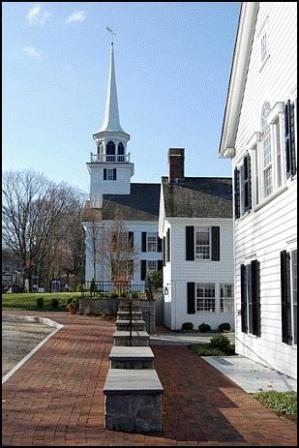
February 9, 2014
Rev. Reebee Kavich Girash, Guest Preacher
Scripture Readings
Isaiah 58:1-12
Matthew 5:13-20
Sermon
What extraordinary parallels in imagery between the Matthew and Isaiah text today. Your light shall break forth like the dawn – and you are the light of the world. More than light links these passages, they are connected by the imperative to act justly, with attention to the wider world, for the sake of the glory of God, and the sake of building the world God wants. Look to the needs of the world if you are to be a city on a hill; look to the needs of the world if you wish practice the fast that God chooses.
Don’t hide your light under a bushel. Our fast is not for our own self-interest but to loose the bonds of injustice and minister to our neighbors.
I was particularly struck by a phrase at the end of the Isaiah text: if the people seek justice and serve the needs of the afflicted, “you shall be like a watered garden, like a spring of water, whose waters never fail.”
Like a watered garden, you shall be.
The same Hebrew word for garden, gan, is used in Isaiah and in Genesis. This is no coincidence but a poetic connection to the people’s deepest roots. A civilization has risen and fallen and is starting to rebuild. God is telling the people, if you act justly you will once again touch a piece of that holy and fertile soil.1
The prophet in Isaiah 58 wants the people to know that if they act with justice and serve their neighbors, a piece of the Garden will be restored.
If we do justice for our neighbors, here and around the world, like a watered garden, we shall be.
But, you asked me here to talk about climate change. What does this have to do with climate change?
Bill McKibben, who is a bit of a modern day prophet on climate change and has spent many hours teaching Sunday School, says that burning fossil fuels, which radically shifts the earth’s climate, is like human beings running Genesis backward.2
So the question is: do we move toward the restoration of the garden, or continue the reversal of creation?
~~
When I’m prepping a sermon, I first study scripture and then I look at local media and see what going on locally around climate change. This is my version of what Karl Barth and Jim Forbes suggest all preachers do – write with the Bible in one hand and the newspaper in the other.
In Connecticut there’s one word that leaps off the page: Sandy. We cannot say with certainty that any one storm is a direct result of climate change, but we can look at the increased frequency of extreme weather events and link that to climate change. Superstorms are becoming normal storms. Sandy has shown all of us in the Northeast what it means when climate change hits our coast and affects our neighbors. Six people died in Sandy in Connecticut, 600,000 lost power and as of the one year anniversary some people in Milford were still out of their homes.3 Back in 2009 your own state department of environmental protection issued a report that said “Future climate change impacts to Connecticut’s treasured coastline could be substantial.”4 Five years later that “could be” has become “is already.”
So, here in eastern Connecticut you have a double challenge, when it comes to climate change: to work on mitigating climate change for the sake of our neighbors around the world and our children and generations to come – and to work on adapting your coastal region to the inevitable impacts of climate change. I mean, I’m assuming you here in Wilton are not interested in front yard beaches.
The scientific consensus is that climate change is real, and human caused. Some folks say, God has promised never again to flood the earth, so really, we have nothing to worry about. But God never said, I won’t let humanity flood yourselves.
There’s some crucial science background I want to cover to fill in the big picture. Since I am not a scientist and this is not a science class it will be very brief: really just five numbers. You may know them already. I share them because they’ve become part of my story – and the urgency that has caused me to move from being an earth steward in the broad sense, to be a climate activist.
1) The world is already .8 degrees C warmer due to climate change, and our weather patterns show increasing drought, wildfires, flooding, and extreme storms. Folks from Connecticut to Malawi people are already dying because of climate change.
2) The international scientific community thinks we need to keep the temperature rise under 2 degrees C in order to maintain a climate compatible with human civilization. In order to maintain a climate compatible with human civilization. 2 degrees of change would still be pretty difficult for earth’s inhabitants. Seas rising, more extreme storms, famine and disease. Resource wars and climate refugees will increase. 2 degrees still means, pretty likely, your grandchildren’s Connecticut coast will be very different. Consider the current drought in California, endangering water supplies, just a foretaste. Consider Typhoon Haiyan just an early indicator.
3) The International Energy Agency says we’ve got less than four years to stop building new fossil fuel infrastructure to stay under two degrees.5. That means, no new coal plants, no new fracking wells, four years to change direction on energy. We don’t have to close all the old ones in that time, but we have to stop building new fossil fuel infrastructure. 4) Scientists tell us we can only burn another 565 gigatons of fossil fuel before we lock in 2 degrees of warming. 5) But the fossil fuel industry has 2795 Gigatons of fossil fuels in reserve.6 So right now the climate action movement is about keeping most of the fossil fuel reserves in the ground – work that is politically tough, work that goes against the most profitable industry in the world, and work that comes with a hard deadline. And work we all need to be part of, because everyone who enjoys living on earth, and everyone who cares about children inheriting a livable world, should be climate activists. As Christians, we are called to worry about climate change because God entrusted the earth to our care, and asked us to take care of neighbors, too.
Climate change is getting worse so quickly, and intersects with and exacerbates so many other justice issues, that I believe it has become our most urgent global crisis. In Bridgeport, CT it intersects with issues of race, class, and public health in the area surrounding the coal plant. In Malawi, aid workers will tell you that climate change exacerbates drought and changes growing seasons, affecting women’s and children’s health. In Texas, it intersects with landowner’s rights and in Alberta it is the latest disruption of First Nations’ communities. In China, the intertwined issue of particulates released by burning fossil fuels means entire cities wear masks and avoid going outside. In Charleston, West Virginia, the processing of coal means you still can’t drink the water. That’s the moral imperative to move off fossil fuels, and to address climate change: it affects every part of our world, and every part of our children’s lives.
So, that’s dramatic.
A friend asked if I was coming down here to put the fear of God into you. I said the science is frightening enough.
I am part of a group that does house parties about climate change with moms,7 and there is a moment in each of those conversations, when those numbers I mentioned sink in, when the dire future that may come to our children sinks in, and I see tears around the room. This is deeply frightening.
I hear college students, on the front lines of climate action, who are deeply afraid of the world they will live in thirty years from now. I have sat with a Dorchester mom who is scared for her son’s lungs.
As people of faith, how do we respond? Well, first and foremost, we respond – we don’t stand by. We become part of the movement. And we respond authentically, from our faith – from our calling to love our neighbors and from the deep hope of our faith. It is crucial to proclaim, from authentic conviction, a better future is possible. There is hope. The work is hard, but there is hope.
So today I what I want to do is put the hope of God into you, so that you will join in this movement, acting to preserve a livable climate. There is hope: but it’s hope that depends on action.
What then should Wilton UCC folks do? How does a Christian community join the movement? I know you are already doing a lot, individually and in town, and I applaud Wilton Go Green’s work! But I urge you to step up and do more – knowing that each of you will be ready for a different level of action somewhere in this list: Sign up for renewable electricity. Bike to work. Eat local. Jump into Mission 4/1 Earth as a church. Pray for wisdom and the courage to act boldly. Show up at rallies. Consider divestment. Call your senators. Help shut down that last Connecticut coal plant (and don’t replace Bridgeport Harbor with another fossil fuel plant – work for a just transition to renewable energy and good jobs for the workers)8. Or stand with your brothers and sisters of the Austin Heights Baptist Church of Nacogdoches, TX, who have just this week called out to to people of faith to unite in opposition to the Keystone XL Pipeline which will run within a mile of their homes.9 Or sit down with your neighbors here, Connecticut UCC, and the Healthy Connecticut Alliance, and the Interreligious Eco-Justice Network and say, how can I be part of this?
Oh, I forgot one on my list: Do be sure to change your lightbulbs.
Change your lightbulbs. If I were penning a modern paraphrase of our Gospel this morning it would include this verse: “No one after changing a lightbulb puts it under the bushel basket, but shines light on renewable energy to all in the house, the neighborhood, and the state.” Climate action is not just a personal lifestyle choice, it’s a movement for justice.
Hear me: if you care about ensuring a livable climate for all the children of our world, it is no longer enough to change your own lightbulb. You need to let that light shine. Be the city on the hill, be salty prophets of systemic change. I’m reminded of the words of Cornel West, “Justice is what love looks like in public.” So when you change your lightbulbs, do it as part of a movement to to shift the public narrative so that everyone knows what we face. It’s only when there is a critical mass calling for action, when there is political and social and economic will, that we’ll see the change we need. So with hope, step out into the world and work for change.
Church, you can be a blessing to the climate movement by rooting your action in the fertile soil of Christianity, and acting with hope and love. In the midst of storm surges and rising seas, you can point to the one who calmed the sea. When sand erodes beneath your feet, find the Rock to stand on and make room for your neighbors. When the outcome seems inevitable, when the powers that be say, there’s no other way, when they say our economy, our society, our government could not possibly operate without more and more and more fossil fuels – call upon the One who turned everything upside down and let him help you envision a redeemed and transformed world. When the reversal of creation seems the inevitable path – choose instead to be a watered garden, choose instead to proclaim hope in a better future.
Church folks haven’t cornered the market on hope, but our faith keeps hope central to our work. And our hopefulness, deliberate and radical hopefulness, salty, bright hopefulness, gives strength to folks throughout the climate action movement. Ours is not a Pollyanna hopefulness, it is hopefulness that has come through Good Friday. Offering the hope we find in our faith gives people the strength to defy despair.
My friend and fellow climate activist, the Rev. Margaret Bullitt-Jonas says this: “we bear witness to the Christ who bursts out of the tomb, who proclaims that life, not death, has the last word, and who gives us power to roll away the stone.”10 Through the Spirit of the risen Christ, we are sent out to act, to do what we can to transform the world, to be repairers of the breach.
Friends, Jesus was the one who said, terrible things are coming but I will rise, and through me you will have new life. He was the one who said, the Kingdom of God is like….and then said: you can build it. He was the one who said: You are the salt of the earth. You are the light of the world. You are the city on the hill.
There is hope, that the world can be reoriented, revived, restored. There is hope for a just and sustainable future for our children. Jesus said, the Kingdom of God is like…and then said: you can build it.
This is what I know: we can do all things through Christ who strengthens us. We can even love, and respect, and partner with our neighbors enough to heal this planet we share.
Folks, I believe the scientific consensus on climate change: that human activity has harmed our ecosystem, that the fish of the sea, the birds of the air, the fruits of the soil – and most definitely human beings, children of God – are already suffering as a result of that harm, and that our deadline for the healing of the earth is fast upon us. I believe the science, but I also believe in something else: I believe in God, our Creator, our Redeemer, our Sustainer. Our source of hope. Our peace which passes all understanding. The great Love who sends us forth to love our neighbors.
Last week I heard Bill McKibben say something at a conference on religious responses to climate change: “The benefit of faith is hope – that if we do all we can, maybe the world will meet us half way. Maybe some force will recognize the love and strength we are putting forth.”11
That sure sounds like Isaiah’s hopeful words, to a people seeking to rebuild.
Listen again to Isaiah:
If you take up the fast that the Lord chooses,
“Then your light shall break forth like the dawn…Then you shall call, and the Lord will answer… if you offer your food to the hungry and satisfy the needs of the afflicted, then your light shall rise in the darkness and your gloom be like the noonday… The Lord will guide you continually, and satisfy your needs in parched places, and make your bones strong; and you shall be like a watered garden, like a spring of water, whose waters never fail.
May it be so, according to the grace of our God and the Lord Jesus Christ. Amen.


 Rev. Reebee Kavich Girash